Uttaradhyayana Sutra · Chapter 21

Story of Samudrapala (समुदपालीया)

Chapter 21 — The Story of Samudrapāla and the Crossing of the Great Sea

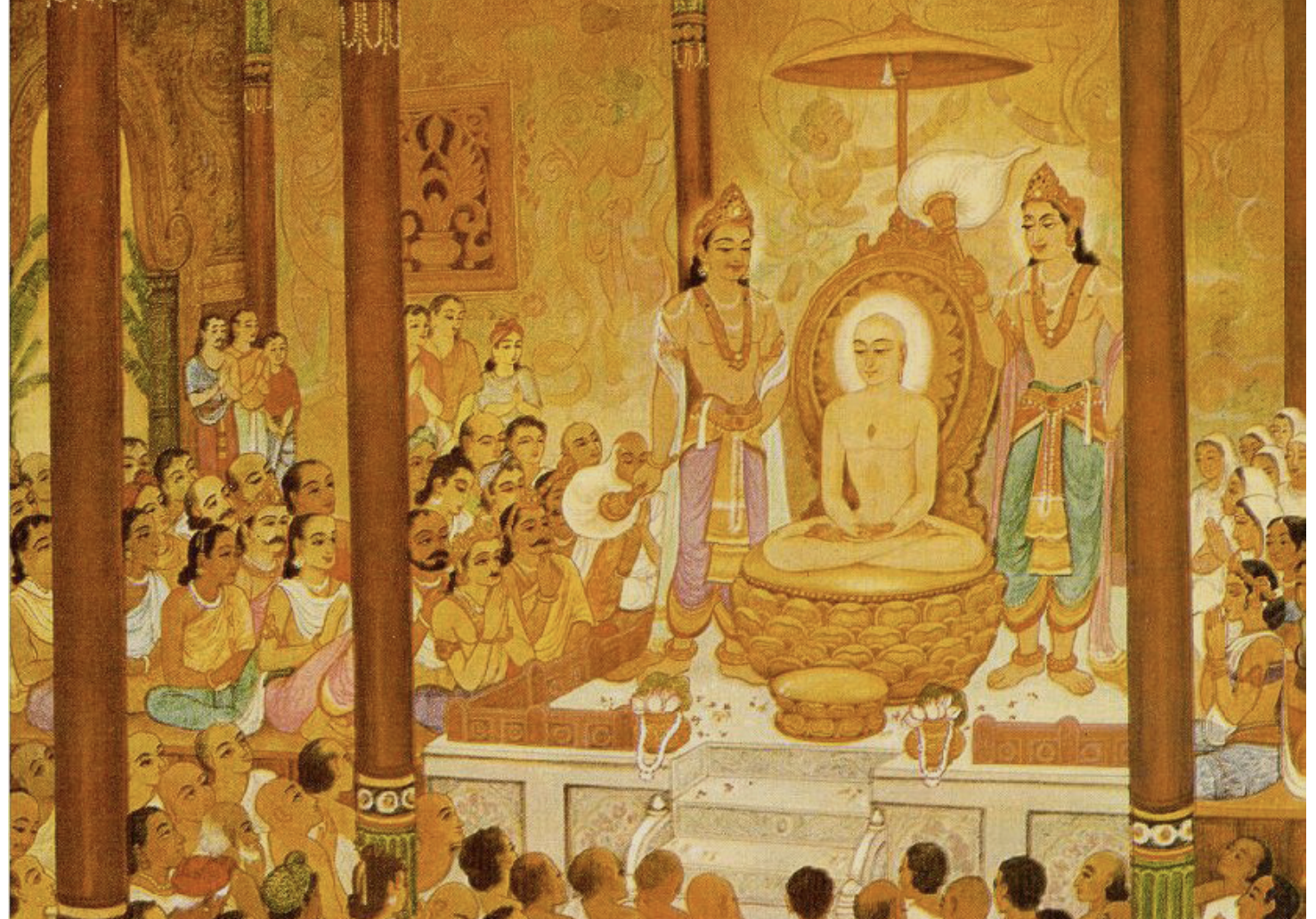
Samudrapāla gazes at the sea

तरित्ता समुद्दं च महाभवोघं, अपुणागमगं गए

“Having crossed the great ocean of saṃsāra, he reached the non-returning destination.”

About This Chapter

Samudrapālīya

Samudrapālīya — the twenty-first chapter — tells the story of Samudrapāla, the son of a wealthy merchant who was born on a ship in the middle of the ocean. Raised in the peak of worldly comfort and learning, his life takes a radical turn when he witnesses a condemned criminal being led to execution.

The chapter transition from a narrative of renunciation into a deep teaching on the monastic life. It describes how the monk move through the world with the courage of a lion and the steadiness of Mount Meru, enduring every hardship without complaint to burn away the ancient cargo of karma.

Chapter Structure

II The Rule of Right Conduct
24 Sutras
Sea-Born Origin
Saṃvega Awakening
Adhyayana 21

The 24 Sutras

Each sutra is presented with the original Prakrit, English translation, and a simplified commentary.

21.1

चंपाए पालिए णाम, सावए आसि वाणिए ।
महावीरस्स भगवओ, सीसे सो उ महप्पणो ॥२१.१॥

In Champa city there lived a lay follower (shrāvaka) named Pālita, a merchant. He was a disciple — a great-souled one — of the Blessed Lord Mahāvīra.

The chapter opens by anchoring the story in Champa city — one of the great ancient cities of the Jain spiritual world — and the person of Pālita, a merchant and devoted shrāvaka. A shrāvaka is a lay disciple — a Jain householder — who takes specific ethical vows while remaining in ordinary life, without full monastic renunciation. Think of it like this: a shrāvaka follows the same five rules a monk does (non-violence, truth, non-stealing, celibacy, non-possession) but in a softer, more flexible form called anuvratas (minor vows), adapted for someone who still has a family, a business, and everyday responsibilities. Pālita moved in the world of trade, buying and selling across sea routes, yet his inner life was structured by Jain ethical formation and the living teachings of Mahāvīra. That he is described as a direct disciple of Mahāvīra himself — the 24th and final Tīrthaṃkara of this cosmic cycle — is enormously significant: it grounds the whole chapter in the most direct possible spiritual lineage. A Tīrthaṃkara is a soul who has achieved infinite knowledge and then teaches others the path to liberation; Mahāvīra is the last such teacher in our current cosmic era. This is not a story that happens in some abstract past; it happens within living memory of the source of the tradition itself. The child who will emerge from this household will carry that formation all the way to its ultimate conclusion — complete liberation from the cycle of rebirth. Every detail of Pālita's life — his faith, his discipline, his courage to live ethically in a world of commerce — is the soil from which his son's extraordinary destiny will grow.

The simple version: In the city of Champa there was a merchant named Pālita, who was a devoted lay disciple of Lord Mahāvīra.

Champa Pālita Shrāvaka
21.2

णिग्गंथे पावयणे, सावए से वि कोविए ।
पोएण वहरंते, पिहुंडं णगरमागए ॥२१.२॥

That shrāvaka was well-versed in the Nirgrantha (Jain) teachings. Engaged in sea-trade by ship, he arrived at the city of Pihunda.

Pālita was learned in the Nirgrantha teachings — "Nirgrantha" literally means "without knots," pointing to a soul freed from karmic entanglement. Imagine karma as thousands of invisible knots tied around the soul, each one created by acts of anger, greed, or delusion; a Nirgrantha is someone working to untie all of them. This is one of the oldest names for the Jain community: the community of the knot-free ones. Yet Pālita also sailed across the sea for trade, moving in the world of commerce and real risk — storms, foreign cities, uncertain returns. Jain narrative literature sees no contradiction here: the shrāvaka lives fully in the world while remaining inwardly anchored to the teachings. The inner compass does not require physical withdrawal. You can be a merchant and still be spiritually serious — what matters is not your profession but the ethical quality you bring to it. His expertise in both — doctrinal depth and maritime trade — makes him an unusually complete figure, someone who has tested his values in the most demanding of practical arenas. The voyage to the distant city of Pihunda sets the stage not only for a marriage but for the birth of his son, the chapter's true hero, whose entire life will retrace his father's sea-voyage on a cosmic scale. The physical ocean Pālita crosses for trade will become the metaphysical ocean his son crosses for liberation — a deliberate parallel the text builds toward from the very first verse.

The simple version: Pālita was both a knowledgeable Jain and a sea-merchant. He sailed to the distant city of Pihunda for trade.

Expertise Sea-Trade Pihunda
21.3

पिहुंडे ववहरंतस्स, वाणिओ देइ धूयरं ।
तं सत्तं पडिगिज्झ, सदेसमह पत्थिओ ॥२१.३॥

While trading in Pihunda, a local merchant gave Pālita his daughter in marriage. Taking his pregnant wife, Pālita departed toward his homeland.

Pālita's righteousness and good character earned him the respect of a local merchant in Pihunda, who offered his daughter in marriage — a gesture of deep trust. This is how Jain narratives often work: ethical living produces real-world rewards, because karma is not only punishing but generative. In Jain philosophy, every action — good or bad — produces karmic particles that attach to the soul and shape future experiences. Pālita's honest, ethical conduct generated auspicious karma that naturally attracted good circumstances, including this marriage alliance. Goodness attracts goodness; this is not luck but the law of karma operating visibly. The child who will become the chapter's true hero is already present, growing in the womb before the homeward voyage even begins. This is a deliberate storytelling choice: the text announces the pregnancy before departure so that we understand the birth-at-sea that follows is not an accident but a destiny already forming. By announcing the pregnancy first, the text sets up the literal truth behind the name Samudrapāla — "guardian born of the ocean." The name will prove true in ways far beyond the physical circumstance of his birth, pointing to the ultimate crossing he will one day make. In Jain tradition, names are rarely accidental — they often encode a soul's entire arc, visible only in retrospect.

The simple version: A merchant in Pihunda gave his daughter to Pālita in marriage. Pālita then began the voyage home with his pregnant wife.

Marriage Journey Home Seeds of Future
21.4

अह पालियस्स घरणी, समुद्दम्मि पसवइ ।
अह दारए तहिं जाए, समुदपालि ति णामए ॥२१.४॥

During the sea voyage, Pālita's wife gave birth to a son. Since he was born at sea, he was named Samudrapāla.

The name Samudrapāla — "one who guards or is born of the ocean" — records the literal circumstance of his birth but also anticipates his entire spiritual trajectory. In Jain philosophy, saṃsāra (the cycle of rebirth) is repeatedly compared to a vast, turbulent ocean that living beings drown in, lifetime after lifetime, swept along by the currents of karma without finding the far shore. The final verse of this chapter will use this exact image to describe his liberation. So birth at sea is not a mere geographical accident — it is a liminal beginning: a soul literally entering life at the boundary between worlds, between the known city of origin and the vast open sea beyond. The text is already narrating two stories simultaneously: the story of a merchant's son and the story of a soul crossing the ultimate ocean. He who was born while physically crossing the sea will ultimately complete his life by crossing the great ocean of existence itself, reaching the "non-returning destination" — liberation.

The simple version: While sailing home, Pālita's wife gave birth to a son at sea. They named him Samudrapāla — born of the ocean.

Samudrapāla Sea-Birth Naming
21.5

खेमेण आगए चंपं, सावए वाणिए घरं ।
संवड्डुइ घरे तस्स, दारए से सुहोइए ॥२१.५॥

The shrāvaka safely returned to his home in Champa city. The boy Samudrapāla grew up happily in his father's house.

Samudrapāla grew up in conditions of genuine well-being — materially secure, physically safe, and spiritually formed by a shrāvaka household. Pālita's home was not merely wealthy; it was a household shaped by ethical commitment, by regular hearing of the Nirgrantha teachings, and by the example of a father who had walked the sea for honest trade without compromising his values. In Jain storytelling, this kind of upbringing matters deeply: a soul does not suddenly choose radical renunciation out of nowhere. The conditions that make such a choice both possible and sustainable are planted long before the decisive moment arrives. Think of it like a field: the right soil must be prepared, the right seeds sown, and the right weather endured before the fruit appears. Pālita's house was precisely the right soil for the seed of liberation — and Samudrapāla's happy childhood was not a distraction from his destiny but a preparation for it. The stability he experienced would give him something real to release.

The simple version: The family safely reached Champa, and Samudrapāla grew up happily in his father's house.

Return Secure Upbringing Formation
21.6

बावत्तरि कलाओ य, सिक्किखए णीइकोविए ।
जोवण्णेण य संपण्णे, सुरूवे पियदंसणे ॥२१.६॥

He learned the 72 arts and became expert in ethics and propriety. Endowed with youth, he was handsome and pleasing in appearance.

The 72 arts (kalā) were the ancient Indian standard measure of full human development — a curriculum that ranged from music, dance, and poetry to archery, mathematics, sculpture, and courtly etiquette. Mastering them was proof that a young person had genuinely developed their human faculties across every dimension of life and culture. It took years of disciplined effort; Samudrapāla devoted himself to that effort completely. But the text adds something crucial: he was also trained in nīti — ethics and right conduct — not just technical skills. He understood not only how to do things but why certain things should or should not be done. He was, by every conventional measure, a complete and fortunate young man. This completeness matters deeply to the story: Mahāvīra's teachings draw forth the greatest renunciations from those who have the most to give up, precisely because such a person's choice carries the most instructive weight for everyone watching. A beggar leaving behind nothing teaches less than a prince leaving behind everything.

The simple version: Samudrapāla mastered the 72 arts, was trained in ethics, and grew into a handsome, accomplished young man.

72 Arts Ethics Accomplishment
21.7

तस्स रूववइँ भज्जं, पिया आणेइ रूविणिं ।
पासाए कीलए रम्मे, देवो दोगुंदओ जहा ॥२१.७॥

His father brought him Rūpiṇī, a beautiful bride. He enjoyed himself pleasantly in the palace — like a Diguṃdaka deva.

Rūpiṇī literally means "one of beautiful form." She is not merely described as beautiful but as ideally matched to her husband in every dimension — a perfect complement to the life Samudrapāla had built. The palace life they share is compared to the pleasures of the Diguṃdaka devas — a class of celestial beings who live at the absolute summit of heavenly enjoyment, experiencing pleasures that no human existence can match. This is the storyteller placing Samudrapāla not just at ordinary worldly happiness but at the highest imaginable peak of it. Everything the world can possibly offer is simultaneously present: youth, physical beauty, accomplished education, great wealth, a loving and beautiful partner, and a splendid home. No worldly ingredient is missing. The text needs this elaborate setup — and spends three full sutras on it — precisely because the renunciation that follows is all the more striking and instructive when it comes from the midst of absolute abundance, not from the midst of want or disappointment. Giving up what you never had is meaningless; giving up everything, freely, is the truly instructive act.

The simple version: His father arranged his marriage to the beautiful Rūpiṇī, and Samudrapāla lived in his palace in great pleasure and happiness.

Rūpiṇī Palace Life Worldly Peak
21.8

अह अण्णया कयाइं, पासायालोयणे ठिओ ।
वज्झ-मंडण-सोभागं, वज्झं पासइ वज्झगं ॥२१.८॥

One day, standing at the palace balcony, he saw a criminal being led to the execution stake — adorned with the marks of a death sentence.

CautionImpermanence and Death

All worldly things are temporary—clinging to them brings suffering.

The pivot of the entire chapter arrives in a single image: a condemned man being walked through the streets below the palace, marked with the ritualized signs of his death sentence. The text uses the word "adorned" with sharp irony — the condemned man is "adorned" with the marks of his execution just as Samudrapāla is adorned with his jewelry and royal garments above. It is the darkest possible counterpoint: ornaments of life up high, ornaments of death down below. He is watching from the balcony, the highest point of worldly security and comfort, and below him moves the starkest possible symbol of karmic consequence made visible — what bad karma produces, displayed in public. In Jain biography and narrative literature, this kind of vivid confrontation with reality — called pratibodha, an awakening shock — is the moment when a soul that has been preparing across many lifetimes finally receives the decisive signal. It is not the cause of the awakening; it is the trigger of an awakening that was already overdue. Samudrapāla was ready; the sight of the condemned man was simply the key that opened the already-prepared door.

The simple version: One day from his palace balcony, Samudrapāla saw a criminal dressed in the marks of his death sentence being led to execution.

Observation Execution Pratibodha
21.9

तं पासिऊण संविग्गो, समुद्पालो इणमब्बवी ।
अहो असुभाणं कम्माण, णिज्जाणं पावगं इमं ॥२१.९॥

Upon seeing that, Samudrapāla became filled with saṃvega and said: "Alas! This is the sinful and sorrowful final fruit of inauspicious karmas — here directly witnessed."

Saṃvega is one of the most important and precise terms in Jain spiritual psychology. It is the inner movement — like a deep trembling of the whole being — when the soul truly and viscerally perceives the suffering-producing nature of karma and the complete futility of continuing in ordinary worldly life. It is not mere sadness, nor simple fear of death, nor temporary depression. It is something stronger: a clear-eyed, settled recognition that this cycle has to end and that the tools to end it actually exist. Saṃvega is the beginning of genuine spiritual motivation. Samudrapāla's words are precise: he is not theorizing at a distance. He has just seen the terrible fruit of inauspicious karmas made visible, made tangible, in another person's fate right in front of him. His insight — "this is what karma produces" — is not an intellectual conclusion carefully reasoned out in a library. It is direct knowing — pratyakṣa — the kind of seeing that lands in the whole body and permanently changes the direction of a life. Such moments cannot be manufactured, but they can be prepared for. Samudrapāla was prepared.

The simple version: Seeing the condemned man, Samudrapāla was struck by deep spiritual awakening and exclaimed: "This is the terrible fruit of bad karmas — I can see it directly."

Saṃvega Direct Vision Karmic Fruit
21.10

संबुद्धो सो तहिं भगवं, परमसंवेगमागओ ।
आपुच्छ अम्मापियरो, पव्वइए अणगारियं ॥२१.१०॥

Right there, the fortunate Samudrapāla attained perfect awakening and supreme saṃvega. Taking his parents' permission, he took dīkṣā into the homeless monastic life.

Jain PrincipleMoksha · Liberation

Freedom from karma and rebirth is the soul's eternal home.

Complete awakening — sambodhi — arrived right there, in that moment on the palace balcony. This is the text's most radical claim: liberation-oriented insight can arrive in an instant, when the soul is truly ready. The Jain understanding is that Samudrapāla's preparation across many previous lives — accumulating the right karmas, the right dispositions, the right family environment — made this single moment possible. Awakening does not come from nowhere; it comes from everything. Before taking dīkṣā — the formal monastic initiation — he seeks his parents' permission. This is not hesitation or uncertainty; it is the final act of householder responsibility, the last courtesy of a son who respects the bonds of family while simultaneously recognizing that those bonds cannot hold him. The asking of permission is itself a teaching: even in the act of departure, the monk-to-be maintains the ethical quality that made him ready for departure. After that bow, the life of the palace — with all its beauty, all its pleasure, all its abundance — is over. The ocean of saṃsāra is what remains to be crossed. And Samudrapāla was born ready.

The simple version: Samudrapāla attained complete spiritual awakening then and there. He asked his parents' permission and took dīkṣā, becoming a homeless monk.

Awakening Dīkṣā Departure
Part II — The Rule of Right Conduct
21.11

जहितु सग्गंथ महाकिलेसं, महंतमोहं किसिणं भयावहं ।
परियायधम्मं चाभिरोयएज्जा, वयाणि सीलाणि परीसहे य ॥२१.११॥

Having abandoned complete attachment — the great affliction, total delusion, and all that is fearful — he became devoted to the path of renunciation, the vows, the precepts, and patient endurance of hardships.

Jain PrincipleTyaga · Renunciation

Voluntarily releasing worldly attachments leads to spiritual freedom.

CautionMoha · Delusion

False perception of reality keeps the soul bound in karma.

With sutra 11, the chapter pivots sharply from narrative to teaching. The story of Samudrapāla's awakening is complete — we watched a merchant's son born at sea, raised in spiritual formation, and struck by liberation-insight in an instant. Now, Mahāvīra himself is speaking: these sutras are his direct instructions on what the monastic life actually looks like from the inside. Renunciation is not simply the absence of worldly life; it is a structured, active practice with three named pillars. The mahāvratas are the five "great vows" — the complete commitments that define Jain monasticism (non-violence, truth, non-stealing, celibacy, non-possession). The śīlas are the supporting precepts of discipline that govern daily conduct in detail. And parīṣaha-sahana is the patient, willing endurance of physical and mental hardship — not as torture but as the very mechanism by which old karma is burned away. This is not a soft or purely contemplative path. The muni first releases "great attachment, total delusion, and all that is fearful" — these three are the raw fuel of saṃsāra — and only from that cleared ground can the ordered, alive practice of genuine renunciation begin.

The simple version: Abandoning all attachment, delusion, and fear, Samudrapāla devoted himself to the path of renunciation — its vows, disciplines, and patient acceptance of hardship.

Renunciation Path Endurance
21.12

अहिंस सच्चं च अतेणगं च, तत्तो य बंभं अपिरग्गहं च ।
पडिवज्जिया पंच महव्वयाणि, चरिज्ज धम्मं जिणदेसियं विदू ॥२१.१२॥

The wise muni accepted the five great vows — ahiṃsā (non-violence), truth, non-stealing, brahmacharya, and non-possession — and practiced the Dharma as taught by the Jinas.

Jain PrincipleBrahmacharya · Celibacy

Mastery over sexual desire liberates immense spiritual energy.

The five mahāvratas are the structural backbone of Jain monastic life, and sutra 12 enumerates all five explicitly: ahiṃsā (non-violence toward all beings — not just humans but every sentient creature down to single-sensed organisms), satya (truth in all speech, with no exaggeration or concealment), asteya (not taking anything that is not freely given), brahmacharya (complete celibacy of body, speech, and mind), and aparigraha (total non-possession — owning nothing). Together these five form an integrated architecture of non-harm and ethical integrity that governs every dimension of the monk's life. They are not arbitrary rules imposed from outside; they are grounded in the direct, omniscient insight of the Jinas who have seen — with complete clarity, unclouded by karma — exactly how karma attaches to a soul, exactly what causes suffering, and exactly how binding can be stopped. Brahmacharya and aparigraha in particular are often misunderstood as mere self-denial. In Jain understanding they are the practical expression of recognizing the soul's inherent completeness: nothing needs to be added. To live by these vows is not to follow someone else's rules; it is to align one's existence with directly perceived spiritual truth.

The simple version: Samudrapāla accepted the five great vows — non-violence, truth, non-stealing, celibacy, and non-possession — and lived by the Dharma of the Jinas.

5 Great Vows Jina-Teaching Mahāvrata
21.13

सव्वेहिं भूएहिं दयाणुकंपी, खंतिखमे संजय बंभयारी ।
सावज्ज जोगं परिवज्जयंतो, चरिज्ज भिक्खू सुसमाहिं इंदिए ॥२१.१३॥

Compassionate toward all beings, forbearing, restrained, and celibate, the bhikshu abandons all sinful activities and wanders with senses well-composed.

Four qualities define the inner texture of the monastic person in this verse. First: dayānukampī — literally "one whose compassion moves for all beings" — without exception, not just the pleasant or the human. Jain teaching is precise here: compassion must extend to all sentient creatures, regardless of how small or how alien. Second: kṣānti — patience and forbearance under provocation, insult, and hardship. Third: brahmacharya — complete celibacy extending through body, speech, and mind. Fourth: susamāhia-indria — senses that are well-composed and thoroughly stabilized, not flickering after every stimulus. These are not just virtues to practice in isolation; they are the natural expression of a monk who has genuinely internalized the mahāvratas. "Sāvajja yoga" — sinful or harmful engagement — refers specifically to actions that produce karmic āsrava (influx into the soul). By abandoning these and by stabilizing the senses that would otherwise drag the mind toward their objects, the monk does not merely avoid adding new karma; he actively turns every moment of movement through the world into an opportunity for nirjarā — the active burning and shedding of accumulated karma-particles. Every restrained step is liberation in motion.

The simple version: The monk lives with compassion for all beings, patience, self-control, and celibacy — abandoning all harmful actions and moving through the world with calm, steady senses.

Compassion Restraint Senses
21.14

कालेण कालं विहरेज्ज रट्ठे, बलाबलं जाणिय अप्पणो य ।
सीहो व सद्देण ण संतसेज्जा, वयजोग सुच्चा ण असभमाहु ॥२१.१४॥

The muni wanders through the land at the proper time, knowing his own strength and weakness. Like a lion, he is not frightened by harsh sounds; and having heard words of suffering, he does not respond with cruel or improper speech.

CautionDukha · Suffering

Suffering arises from identifying with the perishable body and desires.

Before a monk moves through the world, self-knowledge — knowing one's own "bala-abala," one's genuine strength and genuine weakness in the present moment — is essential. Without honest self-assessment, discipline collapses precisely when pressure increases. "Kālena kālaṃ" (at the proper time) also signals that the monk does not wander recklessly: timing and discernment in movement are part of the path. The lion simile here does more than evoke raw courage; it describes a specific quality of presence. The lion does not startle at loud sounds; it is not jerked around by stimuli that would scatter ordinary creatures. It moves through the world with deliberate, self-possessed stability. The monk cultivates this same unshakeable quality — specifically toward verbal provocations from others. Insults, harsh words, the cruelty of people who resent his presence — none of these cause him to retaliate with "asabha" speech (cruel, improper, degrading words). This is not passive weakness; it is an active extension of the mahāvrata of ahiṃsā into the subtlest layer of social interaction. In Jain teaching, verbal violence — words intended to harm, demean, or wound — creates karma just as physical harm does. The restrained tongue is as important as the restrained hand.

The simple version: The monk travels wisely, knowing his own capacity. Like a lion unfazed by noise, he is not frightened by harsh words — and he never responds to cruelty with cruelty.

Lion-Like Fearlessness Speech-Restraint
21.15

उवेहमाणो उ परिव्वएज्जा, पियमपियं सव्व तितिक्खएज्जा ।
ण सव्व सव्वत्थाभिरोयएज्जा, ण याविं पूयं गरहं च संजए ॥२१.१५॥

Reflecting on higher truths, the saṃyami wanders, enduring equally all things pleasant and unpleasant. He does not crave all things everywhere, and remains indifferent to praise and blame alike.

The saṃyami — the self-restrained monk — moves through the world with his inner awareness constantly oriented toward what is ultimate, not toward what is pleasant or unpleasant in the moment. The key word "upehamāṇo" (literally: reflecting, contemplating) describes a specific quality of ongoing, active reflective awareness rather than passive wandering or mechanical rule-following. This monk is always thinking about the deeper meaning of what is happening — always orienting experience toward the question of liberation. By enduring all pairs of opposites — pleasant and unpleasant, comfortable and painful, agreeable company and hostile company — with equal steadiness, the saṃyami eliminates the two core engines that drive karma into the soul: rāga (craving and attraction toward what is desired) and dveṣa (aversion and repulsion away from what is not desired). These two are not eliminated by avoiding difficult situations; they are eliminated by meeting all situations with equanimity. The saṃyami is also completely indifferent to pūjā (honor, praise) and garahā (criticism, blame) — the two most powerful social levers that keep most people in a constant state of performance and anxiety. When neither matters, the soul is free to simply be.

The simple version: The monk wanders with his mind on higher things, bearing pleasures and pains equally, not craving or avoiding anything, and unmoved by praise or blame.

Equanimity Upeha Praise & Blame
21.16

अणेगछंदामिह माणवेहिं, जे भावओ संपगरेइ भिक्खू ।
भयभेरवा तत्थ उइंति भीमा, दिव्वा मणुस्सा अदुवा तिरिच्छा ॥२१.१६॥

In this world, humans hold many varied inclinations. The difficulties that arise against the bhikshu include terrible and fearful ones — from devas, humans, or animals.

The bhikshu moves through a world that will not be uniformly welcoming or even neutral. People — "māṇava" — have vastly different values, dispositions, and reactions to a wandering ascetic: some are reverent and generous, others are hostile and contemptuous, and many are simply indifferent in ways that can be their own kind of difficulty. This verse names three sources from which the frightening adversities (upasargas — disturbances specifically directed against the monk) may come: from devas or spirits (in the form of supernatural disturbances, visions, psychological pressures), from humans (insults, physical violence, theft, obstruction), and from animals (bites, attacks from dogs or bulls, dangerous encounters in the wild). By naming all three categories explicitly, the text is doing something important: it is training the monk in realistic expectation before anything happens. Jain monastic training does not promise a peaceful, protected life. It promises that the path itself is worth every difficulty encountered on it. A person who has been honestly prepared for adversity will not be broken by it when it arrives — because the arrival confirms what was already known. Anticipating difficulty is preparation and wisdom, not pessimism.

The simple version: People in this world have many different attitudes toward monks. Terrible difficulties can come from devas, humans, or animals — and the monk must be ready.

Adversity Upasarga Preparation
21.17

परीसहा दुव्विसहा अणेगे, सीयंति जत्थ बहु कायरा णरा ।
से तत्थ पत्ते ण विहज्ज भिक्खू, संगामसीसे इव णागरायां ॥२१.१७॥

Many hardships are unbearable, and cowardly men break and wilt under them. But when such hardships befall the bhikshu, he does not waver — like the king of elephants at the forefront of battle.

Jain monasticism catalogues 22 parīṣahas — specific categories of hardship that the monk must learn to endure without wavering: hunger, thirst, cold, heat, insect bites, nakedness, physical discomfort, the distress of homelessness, grief, illness, violent physical contact, and more. These 22 categories are not optional trials one might elect to avoid; they are built structurally into the wandering mendicant life. The Jain tradition is completely candid about this. The text says plainly that "many cowardly men" (bahū kāyarā narā) simply break and "wilt" (sīyanti — literally: wither, like a plant without water) under even a few of these hardships. There is no shame attached to acknowledging the difficulty; the point is contrast. The bhikshu, however, does not waver — "na vijjhā" — when these hardships fall upon him. The image of the nāgarāja — the elephant king — at the forefront of battle is precise and chosen carefully. This is not the ferocity of aggression; it is the quality of unshakeable, rooted presence under the maximum pressure of battle. The lead elephant does not flee from noise and danger; it holds the entire line steady. The bhikshu's courage in Jain teaching is exactly this: not the absence of feeling hardship, but the immovability of one who has chosen the path regardless of what the path brings.

The simple version: Many hardships break ordinary people. But when these same hardships fall on the bhikshu, he stands firm — like the lead elephant at the front of a battle, immovable.

Elephant King Steadiness Hardship
21.18

सीओसिणा दंसमसगा य फासा, आयंका विविहा फुसंति देहं ।
अकुक्कुओ तत्थिहासएज्जा, रयाइं खेवेज्ज पुरेकडाइं ॥२१.१८॥

Cold, heat, mosquitoes, flies, and various contacts — diseases and afflictions of many kinds touch the body. Without complaint, he endures them calmly and destroys previously accumulated karmas.

This sutra grounds the teaching in precise physical reality: the specific hardships listed — cold (śīta), heat (uṣṇa), mosquitoes (daṃśa), flies (maśaka), and "viviha phāsā" (various bodily contacts — meaning rough ground, thorns, hostile surfaces, vermin) — are the basic daily texture of a wandering monk's life. These are not dramatic crises; they are the ordinary, unceasing small assaults of life lived without shelter, comfort, or protection. Then "āyaṃkā" (diseases and afflictions) add the dimension of prolonged illness. The monk does not seek these out as a form of self-punishment or dramatic spiritual theater. They simply arise — and they always will. The key word here is "akukkuo" — literally "without agitation," without complaint, without the inner restlessness of one who needs the situation to be different from what it is. This inner orientation is what transforms the situation. In Jain philosophy, old karma-particles (purekadā raya — previously accumulated karmas) can be actively destroyed through patient, willing endurance of physical hardship. This process is called nirjarā — the shedding of karma. The same cold, the same mosquito bite, the same illness that would be pure meaningless suffering for an unrestrained person becomes an act of liberation for the monk who receives it with the correct inner stance of akukkua. Endurance, rightly oriented, is the alchemy that converts suffering into freedom.

The simple version: Cold, heat, insects, and disease touch the monk's body. He bears them without complaint — and in doing so, destroys the karmas he previously accumulated.

Body-Pain Nirjarā Non-Complaint
21.19

पहाय रागं च तहेव दोसं, मोहं च भिक्खू सययं वियक्खणो ।
मेरुव्व वाएण अकंपमाणो, परीसहे आयगुत्ते सहेज्जा ॥२१.१९॥

Always abandoning attachment, aversion, and delusion, the wise bhikshu endures hardships self-protected and unshaken, like Mount Meru unaffected by wind.

CautionMoha · Delusion

False perception of reality keeps the soul bound in karma.

Rāga (attachment and craving), dveṣa (aversion and hatred), and moha (delusion — the fundamental confusion about what the self truly is) are the three fundamental roots through which karma attaches to the soul. In Jain analysis, every harmful action in every lifetime throughout beginningless saṃsāra traces back to one of these three, or to some combination of them. The wise bhikshu — "viyakkhaṇo," the discerning one, the one who sees through illusion — releases all three not just occasionally when it is convenient, but "sayayaṃ" (always, continuously, without interruption). This is not an ideal to aspire to some day; it is the living quality of practice in each moment. The simile of Mount Meru is not decorative; it is theologically precise. Meru is the great cosmic mountain at the center of the Jain universe — utterly unmoved by wind, unchanging amid all cosmic cycles. The monk who has established his inner axis in ātmagupta — "self-protected," literally guarded by the soul's own awareness — does not need any external armor, external reassurance, or external approval. He is protected by the soul's own clarity from the inside, the soul's own natural light shining through as karma thins. In Jainism, this clarity — ātman as pure consciousness, bliss, and knowledge — is the soul's actual natural state, which karma has been obscuring. Endurance in practice progressively removes that covering.

The simple version: Always releasing attachment, aversion, and delusion, the wise monk endures every hardship unmoved and self-protected — like Mount Meru standing firm against the wind.

Mount Meru Inner Axis Self-Protection
21.20

अणुण्णए णावणए महेसी, ण याविं पूयं गरहं च संजए ।
स उज्जुभावं पडिवज्ज संजए, णिव्वाणमग्गं विरए उवेइ ॥२१.२०॥

The great sage is neither elated nor depressed; the saṃyami is indifferent to both praise and blame. Accepting straightforwardness, the saṃyami — detached from sensual pleasures — attains the path of nirvāṇa.

"Ujju-bhāva" — straightforwardness — is a key ethical quality in Jain thought that deserves more attention than it usually receives. It means the complete alignment between one's inner life and outer expression: the person who thinks, speaks, and acts without contradiction, concealment, performance, or pretense. To be ujju (straight) is to be the same in public as in private, to say what one means and mean what one says. This is not simplicity or naivety; it is a quality of integrity that removes a whole layer of the subtle identity-construction that keeps the ego in motion. The great sage — "mahesi" — who is "anunnae na avanae" (neither elated nor brought down) has mastered the two most powerful levers through which the social world attempts to manage people: pūjā (honor and praise) and garahā (blame and criticism). These are the two faces of social approval, which most people spend enormous energy navigating. The monk who is genuinely indifferent to both has stepped entirely outside that game. Having also achieved "virata" — detachment from sensual pleasures, meaning genuine disinterest rather than mere suppression — such a monk finds himself naturally on the nirvāṇa path. He is not walking toward it from far away; he is inhabiting it in the present. Detachment is not emotional coldness; it is the freedom of one no longer propelled by craving into action that generates karma.

The simple version: The great sage is unmoved by praise or blame, unshaken by good or bad fortune. Accepting simplicity and releasing desire, the monk walks naturally on the path to nirvāṇa.

Straightforwardness Indifference Nirvāṇa
21.21

अरइरइसहे पहीणसंथवे, विरए आयहिए पहाणवं ।
परमट्टपएिहं चिट्ठु, छिण्णसोए अममे अकिंचणे ॥२१.२१॥

Bearing both arati and rati equally, having abandoned worldly associations, detached, contemplating the self — he stands established in the supreme goal, with grief severed, free of possessiveness and all attachment.

Jain PrincipleTyaga · Renunciation

Voluntarily releasing worldly attachments leads to spiritual freedom.

CautionSanga · Attachment

Emotional bonds to people and things perpetuate suffering.

Arati and rati are two Prakrit words that name the two opposing pulls that constantly tug at the renunciant's inner life. Arati is the discomfort that sometimes rises in the life of renunciation — the physical tiredness, the monotony, the longing for ease or warmth or familiar comfort. It is the inner voice that says "this is hard; perhaps I should not have chosen this." Rati is the opposite pull: the magnetic attraction of worldly pleasures, the vivid memory of sensory enjoyment, the temptation to return to the life that was left behind. Both are forms of restlessness. The monk who can bear both equally — without fleeing into comfort when arati arises, and without being seduced by rati when it beckons — has achieved a genuine and stable inner equilibrium. He is no longer being moved by the world's pushes and pulls. The text says he "ciṭṭhu" — stands established — in the supreme goal. This is not someone walking toward liberation from far away; it is someone who already dwells in what liberation is. The final cluster of qualities describes this present state with precision: "acchinna-sota" means grief has been severed at its root (not suppressed but genuinely cut); "amama" means having no sense of "mine-ness," no possessiveness about anything; and "akiñcana" means having literally nothing to hold onto — complete non-attachment. These are not future aims. They are this monk's present condition.

The simple version: The monk bears equally the discomfort of renunciation and the pull of pleasure, has released all worldly ties, and stands established in liberation — with no grief, no possessiveness, no attachment.

Arati-Rati Non-Possession Established
21.22

विवित्त लयणाइं भएज्ज ताई, णिरुवलेवाइं असंथडाइं ।
इसिहिं चिण्णाइं महायसेहिं, काएण फासेज्ज परीसहाइं ॥२१.२२॥

The monk should resort to secluded dwellings — free from attachment, without seeds or household companions — as practiced by the great-famed sages, and with his body endure the hardships that come.

CautionSanga · Attachment

Emotional bonds to people and things perpetuate suffering.

The monk's choice of dwelling is not a matter of comfort or convenience; it must serve his practice and protect the conditions necessary for deep inner work. "Vivitt layanāi" — secluded resting places — describes locations where the basic conditions for meditative life exist: quiet, undisturbed, away from crowds and the noise of household activity. "Niruvaleya" (free from attachment — specifically free from the soil's attachment to growing things, meaning places without vegetation the monk might harm by walking on) and "asaṃthaḍa" (without seeds and without household companions) specify the additional Jain requirements for the monk's resting place. These are not punitive restrictions. They are conditions that protect two things: the outer environment (non-violence toward the small lives in rich, seeded soil) and the inner environment (freedom from the social and emotional pulls of household life, even in diluted form). The monk cannot do the deep tapas (austerity and energy-practice) and dhyāna (meditation) needed for liberation while embedded in domestic entanglements. He protects the inner space by protecting the outer conditions. And when hardships arise even in these deliberately chosen places — as they always will — the monk meets them "kāeṇa" (with the body itself), enduring them directly rather than fleeing. The great-famed sages of the tradition, the text notes, walked this same path. There is lineage in this discipline.

The simple version: The monk should seek secluded, simple resting places — as the great sages have always done — and use his body to endure whatever hardships arise there.

Secluded Dwelling Sage-Path Bodily Endurance
21.23

सण्णाण-णाणोवगए महेसी, अणुत्तरं चरिउं धम्मसंचयं ।
अणुत्तरे णाणधरे जसंसी, ओभासइ सूरिए वंतलिक्खे ॥२१.२३॥

Attaining the highest knowledge, the great sage practices the supreme collection of virtues. That glorious, supreme knowledge-bearer shines in the assembly like the sun in the sky.

Jain PrincipleTyaga · Renunciation

Voluntarily releasing worldly attachments leads to spiritual freedom.

This sutra is the culmination of the entire teaching section that began at sutra 11 — the arc that described renunciation, the five mahāvratas, compassion, fearlessness, equanimity, endurance, and proper dwelling. The monk who has traversed all of these disciplines has now attained "saṇṇāna-ṇāna" — "saṃjñāna-jñāna" — the highest, most fully integrated knowing. This is not the ordinary accumulated learning of study; it is the direct illumination of awareness that arises when karma has been sufficiently removed to let the soul's inherent luminosity emerge clearly. In the Jain framework, the soul's nature is pure knowledge (jñāna) and perception (darśana); what obscures it is karma. Remove enough karma, and what was always there shines through. This fully formed monk then practices the "anuttara dharma-saṃcaya" — the supreme collection of virtues — which in Jainism means the full, active expression of that omniscient awareness in every detail of daily life. The sun simile chosen here is precise and illuminating in its own right: the sun does not try to shine; it does not perform luminosity as an act of will. It shines because of what it fundamentally is. The fully realized monk illuminates every assembly he enters — "vantarikha," the open sky — not by performing wisdom or demonstrating knowledge but simply by being what he has become. His mere presence is teaching. The knowledge lives in him, not in words about him.

The simple version: The great sage attains the highest knowledge, practices the supreme virtues, and shines in the assembly of liberated ones like the sun blazing in the open sky.

Sun Simile Illumination Virtue-Collection
21.24

दुविहं खवेऊण य पुण्णपावं, णिरंगणे सव्वओ विप्पमुक्के ।
तरित्ता समुद्दं च महाभवोघं, समुदपाले अपुणागमगं गए ॥ ति बेमि ॥२१.२४॥

Having destroyed both types of karmas — merit and sin — completely free from all karmas, Samudrapāla crossed the great ocean of saṃsāra and attained the non-returning destination: liberation. Thus I say.

Jain PrincipleMoksha · Liberation

Freedom from karma and rebirth is the soul's eternal home.

The final verse closes Samudrapāla's story with a symmetry so precise it reads like a poem about poetry. He destroyed both types of karma — pāpa (sin, inauspicious karma that brings painful results) and puṇya (merit, auspicious karma that brings pleasant results). This is one of the most distinctive and philosophically rigorous points in Jain teaching, and it must be understood clearly: in Jainism, even good karma must be destroyed to reach liberation. Puṇya — the karma earned through generosity, worship, ethical conduct, and religious practice — still binds the soul to the cycle of rebirth. It creates more pleasant conditions for future births, perhaps even heavenly births, but it does not free the soul. Freedom requires the complete absence of all karma without exception — not just the bad kind. The soul must become "nirañgaṇa" — completely stainless, without any mark or stain — to be finally free. Having achieved this total purity, Samudrapāla crossed the great "mahā-bhavaugha" — the vast flood of existence, the endless churning sea of rebirth. The name-symmetry here is deliberate and beautiful: Samudrapāla was born at sea, carried across the ocean in his mother's womb. He completes his existence by crossing the ultimate ocean — saṃsāra itself — and never returning. "Apunāgamaga" — to the non-returning destination. "Iti bemi" — Thus I say — is Mahāvīra's seal on the entire teaching. The story is complete. The ocean is crossed.

The simple version: Samudrapāla destroyed all karmas — merit and sin alike — and crossed the great sea of existence. He attained liberation, the non-returning state. Thus it is said.

Final Crossing Unstained Iti Bemi
॥ अध्ययन-२१ सम्पूर्ण ॥

End of Chapter 21 — Samudrapālīya

← Ch 20 Ch 22 →