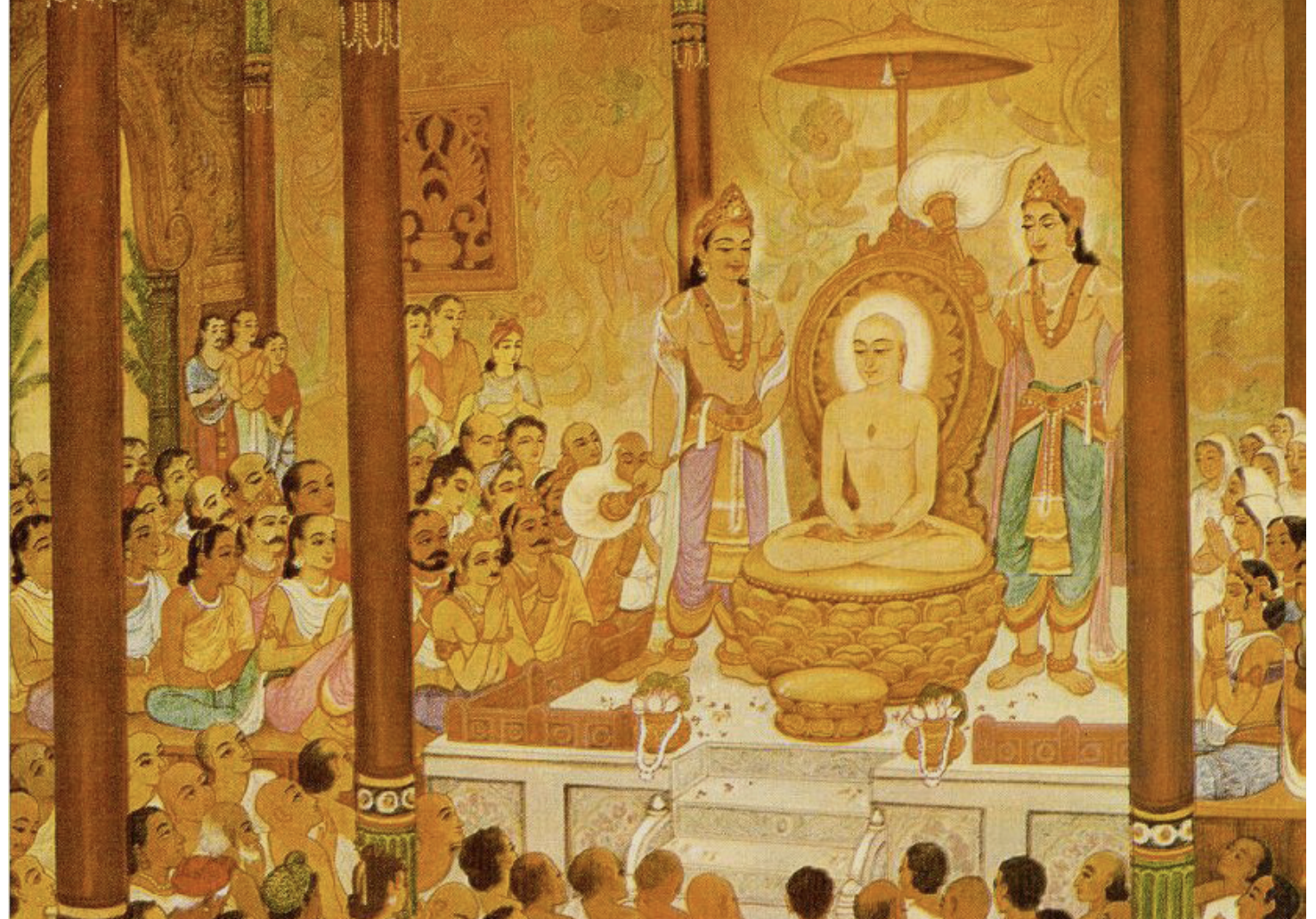
Uttaradhyayana Sutra · Chapter 13

Chitta and Sambhuta (चित्त-संभूतीय)

Chapter 13 — On Five Lifetimes Together, One Path Diverged: The Story of Chitt and Sambhut

Chitt and Sambhut — two paths from one shared past

इक्को सयं पच्चणुहोइ दुक्खं,
कत्तारमेव अणुजाइ कम्मं

“He alone experiences the suffering himself — karma follows only its maker.”

About This Chapter

Chitt-Sambhutiya

Chitt-Sambhutiya — the thirteenth chapter — narrates the reunion of two souls who have shared five consecutive lifetimes as brothers: as servants (dasas) in Dasarna, as animals (deer) at Mount Kalinjara, as geese on the banks of the Ganga, as outcastes (chandalas) in the kingdom of Kashi, and finally as gods in the divine realm.

In their sixth lifetime, Sambhut is reborn as Brahmdatt — the Chakravarti (world-emperor) of Hastinapura — while Chitt becomes a wandering monk in Kampilya. When Chitt arrives at Brahmdatt's court, he traces their entire shared history, explains how a single act of desire (niyāna — a wish made at death) created their divergence, and then delivers the unsparing philosophical teaching: karma follows the maker alone. No relative, no friend, no wife or child shares your karma. Only you reap what you have sown. The chapter ends with the sharpest possible contrast: Chitt attains the highest liberation; Brahmdatt descends to the deepest hell.

35 Sutras
Emperor Addressed To
9 Sections
Adhyayana 13

The 35 Sutras

Each sutra is presented with the original Prakrit, English translation, and a simplified commentary.

Part I — Five Lifetimes as Brothers
13.1

जाइपराजिओ खलु कासी णियाणं तु हत्थिणपुरिम्म । चुलणीए बंभदत्तो, उववण्णो पउमगुम्माओ ॥१॥

Indeed, Brahmdatt — having died in Kashi and having made a death-wish (niyāna) — was born in Hastinapura in the house of Queen Chulani, from a lotus cluster (padmagulma).

CautionImpermanence and Death

All worldly things are temporary—clinging to them brings suffering.

The chapter opens mid-story: Brahmdatt, the world-emperor, is not a random birth. He is the soul of Sambhut, who made a niyāna — a wish or intention made at the moment of death — in Kashi. The niyāna locked his rebirth trajectory. He was born to Queen Chulani of Hastinapura and became Brahmdatt, the Chakravarti. The word "paumagulma" (lotus cluster) describes the manner of his divine birth, marking him as extraordinary from the first moment.

The simple version: Brahmdatt — previously Sambhut — made a wish at death in Kashi and was reborn as the world-emperor of Hastinapura. His ambition from a past life became his present-life destiny.

NiyānaRebirthChakravartiSambhut
13.2

कंपिल्ले संभूओ चित्तो, पुण जाओ पुरिमतालिम्म । सेट्टिकुलम्मि विसाले, धम्मं सोऊण पव्वइओ ॥२॥

Chitt, born again as Sambhut in Kampilya, in Purimatal, in a wealthy merchant's family — hearing the Dharma, he renounced and became a monk.

Chitt's trajectory is the opposite of Brahmdatt's. Born to a prominent merchant family in Kampilya, he heard dharma and renounced — immediately. "Dhammam soun pavvaio" — a single sequence: heard, then renounced. No prolonged deliberation. This swift renunciation contrasts sharply with the entire second half of the chapter, where Brahmdatt is invited to renounce and cannot.

The simple version: Chitt was reborn in a wealthy family in Kampilya. He heard the Dharma — and renounced. One hearing was enough. That is the entire arc of his life in this birth.

RenunciationChittDharma HearingMerchant Family
13.3

कंपिल्लम्मि य णयरे, समागया दो वि चित्तसंभूया । सुहदुक्खफलविवागं, कहेंति ते इक्किमक्कस्स ॥३॥

In the city of Kampilya, both Chitt and Sambhut came together — and they told each other of the fruits and consequences of pleasure and pain.

The reunion is in Kampilya. The two old souls recognize each other and sit together to review the karmic accounting of their shared lifetimes — what pleasure brought, what pain brought, what each life cost. "Sukha-dukha-phala-vivāga" — the ripening of the fruits of pleasure and pain — is the subject of their conversation. This is not nostalgia; it is karmic analysis.

The simple version: Chitt and Sambhut met again in Kampilya and sat together. They told each other what their past lives had produced — what the pleasure brought and what the suffering brought.

ReunionKarma ReviewPleasure and PainKampilya
13.4

चक्कवट्टी महिड्डिओ, बंभदत्तो महायसो । भायरं बहुमाणेण, इमं वयणमब्बवी ॥४॥

Brahmdatt the Chakravarti — of great power and great fame — with great respect for his brother, spoke these words:

The emperor speaks first — and the first thing established is the direction of his respect. Despite being the most powerful man in the world ("mahiddio" — of great power, "mahayaso" — of great fame), Brahmdatt addresses the monk with bahūmāna — deep reverence. Power and royalty bow before renunciation. The chapter has not yet begun its argument, but the structure of respect already encodes it.

The simple version: The world-emperor Brahmdatt — powerful and famous — spoke to his brother the monk with deep respect. Imperial power bows first to spiritual life.

BrahmdattRespect for the MonkImperial Humility
Part II — Past Lives Remembered
13.5

आसिमो भायरा दो वि, अण्णमण्णवसाणुगा । अण्णमण्णमणुरत्ता, अण्णमण्ण हिइसिणो ॥५॥

"We were both brothers — each following the other's command, attached to one another, each gladdening the other's heart."

Brahmdatt begins the recollection. The bond between the two souls is described through three paired adjectives: they followed each other's will (annamanna-vasanuga), were emotionally attached to each other (annamanna-anurata), and were the cause of each other's joy (annamanna-hiiyasino). This triple description builds the emotional case for why separation is so poignant — these were not casual acquaintances across lifetimes, but deeply bonded souls.

The simple version: "We were inseparable brothers — we followed each other's lead, cared for each other deeply, and made each other happy." Five lifetimes of genuine brotherly love.

BrotherhoodPast LivesEmotional Bond
13.6

दासा दसण्णे आसी, मिया कालिंजरे णगे । हंसा मयंगतीरे य, सोवागा कासिभूमिए ॥६॥

"We were servants (dasas) in Dasarna; deer on Mount Kalinjara; geese on the banks of the Matanga (Ganga); chandalas (outcastes) in the land of Kashi."

Four past lives listed in rapid succession — from servant to animal to bird to outcaste. The arc is not upward; it traces the full variety of karmic circumstances these two souls inhabited together. Servant, deer, geese, chandala — across species, across social strata, across geography. What was constant across all four was their togetherness. Location and form changed; the bond did not.

The simple version: In four past lives they were together: servants, deer, geese, outcastes. Different bodies, different places, different conditions — always together. The bond outlasted every form.

Past LivesRebirth Across SpeciesFive LifetimesDasarna
13.7

देवा य देवलोगम्मि, आसिस अम्हे महिड्डिया । इमा णो छिट्टिया जाई, अण्णमण्णेण जा विणा ॥७॥

"And in the divine realm, we were gods of great power. In none of these births did we ever exist — any one of us — without the other."

The fifth past life: as gods of great power in the divine realm. This completes the five-lifetime sequence — servant, deer, geese, chandala, god — with the current birth as the sixth. "Ama no chitthiya jati, annamunnena ja vina" — not one of those births passed without the other being present. The bond was the constant across five rebirths and four species. Now they stand on opposite sides of a spiritual divide that cannot be bridged by attachment.

The simple version: "And even in the divine realm we were gods together. Not one birth, not one life — in none of them were we ever apart." Five lifetimes of unbroken companionship. And now: the divergence.

Divine BirthUnbroken BondFive Lives Together
Part III — The Fruit of Karma
13.8

कम्मा णियाणप्पगडा, तुमे राय विचिंतिया । तेसिं फलिविवागेण, विप्पओगमुवागया ॥८॥

"O king — karma made manifest through the niyāna (death-wish) was contemplated by you. Through the ripening of the fruit of that karma, separation came."

CautionImpermanence and Death

All worldly things are temporary—clinging to them brings suffering.

Chitt now speaks as the monk-teacher. He names the cause of their separation precisely: Brahmdatt (Sambhut in a past life) made a niyāna — a desire-wish at the moment of death — and that desire took form as karma. When that karma ripened, it separated them for the first time in five lifetimes. The niyāna is the pivot of the entire chapter: desire for pleasure, even at the moment of a past life's end, binds the soul to a specific rebirth trajectory.

The simple version: "O king — you made a wish at death. That wish became karma. And when that karma ripened, it pulled us apart for the first time in five lives." One moment of desire; one lifetime of divergence.

NiyānaKarma RipeningSeparationDesire at Death
13.9

सच्चसोयप्पगडा, कम्मा मए पुरा कडा । ते अज्ज परिभुंजामो, किण्णु चित्ते वि से तहा ॥९॥

"The karma I made earlier was made manifest through truth-practice. Those karmas I am now enjoying (reaping). Was it not the same way for Chitt?"

Brahmdatt reflects on his own karmic situation. His karma came from "sacca-soya" — truth-practice, right action. He is now experiencing those fruits. But the turn of the question — "wasn't it the same for Chitt?" — is revealing: he is looking at the monk's liberation and asking whether Chitt's superior outcome comes from superior past karma. The implicit answer is: yes, and the mechanism for both is identical. What differs is the content of what was planted.

The simple version: "The karma I made through right action, I am now reaping. And wasn't it the same for Chitt?" The emperor sees that both of them are living the fruit of seeds from the past.

Karma ReapingPast ActionsComparative Reflection
13.10

सव्वं सुचिण्णं सफलं णराणं, कडाण कम्माण ण मोक्ख अत्थि । अत्थेहिं कामेहिं य उत्तमेहिं, आया ममं पुण्णफलोववेए ॥१०॥

"All well-practiced karma bears fruit for people — there is no release from karma once done. In wealth, in desires, in the highest things — my soul is now receiving the fruit of merit."

This is a foundational karmic statement: all well-practiced karma is fruitful ("sarvam suchinnam saphalam"). There is no escape from ripened karma — "kadan kammana na mokkha atthi." But the emperor is not describing this as a warning; he is describing it as his own fortunate situation. His wealth and imperial pleasures are the fruit of past merit. He thinks he is in a good position. The monk's subsequent teaching will reframe this entirely.

The simple version: "All karma that was properly practiced bears fruit — there is no escape from karma once done. My present wealth and pleasures are the fruit of past merit." The emperor sees his fortune as reward — but the monk will show him what it actually costs.

Karma InfallibilityNo Escape from KarmaMerit Fruit
13.11

जाणासि संभूय महाणुभागं, महिड्डियं पुण्णफलोववेयं । चित्तं पि जाणाहि तहेव रायं, इड्डी जुई तस्स वि य प्पभूया ॥११॥

"You know Sambhut — of great power, receiving the fruit of merit, of great splendor. Know also that Chitt the king — his power and radiance have become immeasurable."

Brahmdatt speaks about both himself and Chitt in the third person, as if stepping back to compare them objectively. Both have "iddhi" (power, attainment) and "juti" (radiance, splendor). But the emperor's power is worldly — measured in armies and kingdoms. The monk's power, as the verse frames it, is spiritual — measured in the immeasurable. The parallel structure conceals an asymmetry that the rest of the chapter will reveal.

The simple version: "You know Sambhut — powerful, honored, the fruit of merit. Know also that Chitt's power and radiance have become immeasurable." But one power is temporary; the other is not.

Two Kinds of PowerWorldly vs SpiritualRadiance
Part IV — Why the Monk Renounced
13.12

महत्थरूवा वयणप्पभूया, गाहाणुगीया णरसंगमज्झे । जं भिक्खुणो सीलगुणोववेया, इहं जयंते समणो म्हि जाओ ॥१२॥

"The great-meaning words born of speech, sung in verse, in the midst of human gatherings — those words of the monks, endowed with virtue of character — in this, I conquered. I became a shramana."

Chitt narrates his own turning point: it was the "mahattharupa vayanappahuta" — the great-meaning words generated through speech, sung in verse and heard in human gatherings — the discourse of monks, full of virtue-qualities, that moved him. He uses the word "jayante" — I conquered — as if renunciation were a victory, not a surrender. For Jain monks, the conquest is internal: of attachment, of craving, of the ego. That inner victory is what made him a shramana.

The simple version: "Hearing the dharma teaching — great words, sung in verse, in public — I was conquered by it. I became a monk." Renunciation as victory over the inner enemy, not retreat from the world.

Dharma HearingRenunciation as VictoryShramanaVirtue Words
Part V — The Emperor's Invitation
13.13

उच्चोयए महु कक्के य बंभे, पवेइया आवसहा य रम्मा । इमं गिहं चित्तधणप्पभूयं, पसाहि पंचालगुणोववेयं ॥१३॥

"Excellent courts, my Kakka and Brahma palaces, the beautiful residences — adorn this house, full of wealth and riches, endowed with the qualities of the Panchalas."

The emperor makes his offer. He invites the monk to come and live in his palace — specifically naming his court's finest palaces (Ucchoya, Kakka, Brahma) and describing the wealth and beauty available. "Pasahi" — adorn, grace, honor — is the verb: the monk's presence would honor the palace. The invitation is genuine in its hospitality and completely blind to the monk's reality. A monk who has renounced possessions is being offered the most prestigious possessions in the kingdom.

The simple version: "Come live in my palace. My finest courts, my most beautiful residences, my wealth — grace them with your presence." The emperor does not yet see the contradiction in this offer.

Imperial InvitationPalatial WealthHospitality
13.14

णट्टेहिं गीएहि य वाइएहिं, णारीजणाइं परिवारयंतो । भुंजाहि भोगाइं इमाइं भिक्खू, मम रोयइ पव्वजा हु दुक्खं ॥१४॥

"Surrounded by dancing women, by songs and music — enjoy these pleasures, O bhikshu. The life of a wandering monk seems to me to be suffering."

CautionDukha · Suffering

Suffering arises from identifying with the perishable body and desires.

The emperor is not being callous — he is being sincere. From within the palace, surrounded by dancers and musicians, the monk's wandering life genuinely appears as suffering. "Pabbaja hu dukkham" — the renunciant life, truly, is pain. He sees homelessness, begging, austerity, and heat and cold as poverty. The monk sees attachment, craving, rebirth, and hell as the real suffering. The chapter's debate is about which perspective is correct.

The simple version: "Enjoy music, dance, and pleasures. Honestly — your monk's life looks like suffering to me." The emperor projects his own values onto the monk's life. The monk will gently, then bluntly, correct him.

Pleasure OfferRenunciation MisunderstoodTwo Definitions of Suffering
Part VI — The Monk's Vairagya Teaching
13.15

तं पुव्वणेहेण कयाणुरागं, णराहिवं कामगुणेसु गिद्धं । धम्मस्सिओ तस्स हियाणुपेही, चित्तो इमं वयणमुदाहरित्था ॥१५॥

Chitt — resting in dharma, seeing the true welfare of that king who was deeply attached to sense pleasures out of old affection — spoke these words:

CautionSanga · Attachment

Emotional bonds to people and things perpetuate suffering.

The verse pauses to describe Chitt's internal state before he responds. He sees: the old affection (pubbaneha) — the bond of five lifetimes. He sees: the king's attachment to sense pleasures (kama-gunnesu giddha). He sees: what is truly for the king's welfare (hiyanupehim). All three together produce the teaching. Chitt does not speak from impatience or indifference — he speaks from the combination of deep love and clear perception. That is what dharma vision looks like.

The simple version: Chitt saw his old friend — still attached to pleasures from five lifetimes of habit. He saw the king's true welfare clearly. And from that combination of love and insight, he spoke.

Dharma VisionLove and ClarityTrue WelfareVairagya
13.16

सव्वं विलवियं गीयं, सव्वं णट्टुं विडंबियं । सव्वे आभरणा भारा, सव्वे कामा दुहावहा ॥१६॥

"All singing is wailing. All dancing is mimicry. All ornaments are burdens. All sense pleasures bring suffering."

CautionDukha · Suffering

Suffering arises from identifying with the perishable body and desires.

Four statements, each flipping the emperor's invitation back on itself. The music — wailing. The dance — mimicry, performance, emptiness. The ornaments — not beauty but weight. The pleasures — not delight but the cause of suffering. "Sarve kama duhavaha" is the core claim of the vairagya tradition: desire-objects do not reduce suffering; they generate it. Each sutra item from sutra 14's invitation is now answered with its true nature.

The simple version: "Singing? Wailing. Dancing? Mimicry. Ornaments? Burdens. Pleasures? All of them bring suffering." The monk takes each item of the emperor's invitation and names what it actually is.

VairagyaTrue Nature of PleasureDispassionKama Critique
13.17

बालाभिरामेसु दुहावहेसु, ण तं सुहं कामगुणेसु रायं । विरत्तकामाण तवोधणाणं, जं भिक्खुणं सीलगुणे रयाणं ॥१७॥

"O king — in sense pleasures that delight only the immature and bring suffering, there is no such joy as the joy of monks who are dispassionate, whose wealth is tapas, who delight in virtue of character."

Jain PrincipleTapa · Austerity

Deliberate practice that weakens karma and strengthens the soul.

CautionDukha · Suffering

Suffering arises from identifying with the perishable body and desires.

The contrast is made explicit. Sense pleasures are "bala-abhirama" — delightful only to the childish, the spiritually immature. They are simultaneously "duhavaha" — suffering-bearing. The monk's joy is the opposite: belonging to those who are "viratta" (dispassionate), whose wealth is austerity (tavo-dhana), and who delight in virtue (sila-gune rata). Two descriptions of joy; only one is real.

The simple version: "O king — sense pleasures only delight children and bring suffering. There is no joy there like the joy of monks who have renounced desire, whose wealth is practice, and who delight in virtue."

Maturity and PleasureMonk's JoyTapas as Wealth
13.18

णरिंद जाई अहमा णराणं, सोवागजाई दुहओ गयाणं । जहिं वयं सव्वजणस्स वेस्सा, वसीअ सोवाग-णिवेसणेसु ॥१८॥

"O king of men — the lowest birth of all people was the chandala birth — the birth among those who have gone to both extremes of suffering. We lived as outcastes despised by all, in chandala settlements."

CautionDukha · Suffering

Suffering arises from identifying with the perishable body and desires.

The monk reaches into the shared past to remind the emperor of what they once were. They were chandalas — the outcaste birth, described as "the lowest of all people." They were "vessa" — despised by everyone — and they lived in outcaste settlements. This is a direct appeal to experiential memory: you know what suffering felt like from the inside. You have lived the lowest of conditions. Do not think the pleasures of your present birth are permanent or protective.

The simple version: "O king — remember when we were chandalas? The lowest birth possible? Despised by everyone, living in outcaste settlements? Do not forget what we were."

Shared Outcaste PastMemory as TeachingHumility
13.19

तीसे य जाईइ उ पाविआए, वुच्छामु सोवाग णिवेसणेसु । सव्वस्स लोगस्स दुगंछणिज्जा, इहं तु कम्माइं पुरेकडाइं ॥१९॥

"In that sinful birth — speaking in chandala settlements, despised by all the world — these were karmas done in a former time."

The chandala birth was not arbitrary — it was the fruit of karma done previously. "Iham tu kammani purekadam" — here, the karmas done before. The outcaste birth was the ripenening of past actions. This is the monk completing the lesson he began in sutra 18: not only remember what you were, but understand why. The body you inhabit, the social position you hold — these are karma's artifacts, not your identity.

The simple version: "That low birth — despised by all — came from karma done in even earlier lives. Even our chandala birth was not an accident but a consequence."

Karma as OriginOutcaste Birth ExplainedPast Karma Ripening
Part VII — The Call to Renunciation
13.20

सो दाणिसिं राय महाणुभागो, महिड्डुओ पुण्णफलोव्वेओ । चइतु भोगाइं असासयाइं, आयाणहेउं अभिणिक्खमाहि ॥२०॥

"Now, O king — you who are of great power, great splendor, receiving the fruit of merit — abandon these impermanent pleasures. For the sake of the soul, go forth into renunciation."

Jain PrincipleTyaga · Renunciation

Voluntarily releasing worldly attachments leads to spiritual freedom.

The monk's direct call. The language acknowledges the emperor's genuine achievements — "mahānubhāgo, mahiddiyo, punnaphalobbheo" — great power, great splendor, fruit of merit. All real. And then the word: "asasayam" — impermanent. All of this is impermanent. "Ayanaheum" — for the sake of the soul. Go forth. The invitation to renunciation uses the same vocabulary as the emperor's invitation to pleasure in sutra 13-14, but inverts the direction entirely.

The simple version: "O king — you are powerful, splendid, and have earned all of this. And all of it is impermanent. For the sake of your soul — go forth."

Call to RenunciationImpermanenceSoul's Welfare
13.21

इह जीविए राय असासयम्मि, धणियं तु पुण्णाइं अकुव्वमाणो । से सोयइ मच्चुमुहोवणीए, धम्मं अकाऊण परिम्मि लोए ॥२१॥

"In this impermanent life, O king — one who does not accumulate merit heavily — grieves when brought to the mouth of death, having not practiced dharma, in the next world."

CautionImpermanence and Death

All worldly things are temporary—clinging to them brings suffering.

The failure mode is named precisely: "dhaniyam tu punnai akuvamano" — one who does not accumulate merit abundantly. "Maccumuhopaniya" — brought to the mouth of death. At that moment, with nothing accumulated, the soul grieves in the next world. "Dhammam akaun parimmi loe" — having not practiced dharma, in the world beyond. The suffering is not now — it is future and certain, as certain as karma itself.

The simple version: "In this impermanent life — if you don't accumulate merit, you will grieve at the mouth of death, having not practiced dharma, in the next world." The cost of delay is paid later, not now.

Death's MouthImpermanent LifeMerit AccumulationNext Life
13.22

जहेह सीहो व मियं गहाय, मच्चू परं णेइ हु अंतकाले । ण तस्स माया व पिया व भाया, कालम्मि तम्मंसहरा हवंति ॥२२॥

"Just as a lion seizes its prey — so does death carry the person away at the final moment. At that time, neither mother, nor father, nor brother can share the burden of that moment."

CautionImpermanence and Death

All worldly things are temporary—clinging to them brings suffering.

The image of death as a lion seizing prey is among the most visceral in the Uttaradhyayana. The verb "gahaya" — seized, grabbed — is physical and sudden. At the moment of seizure, every relationship dissolves into non-participation. Mother, father, brother — "na tassa" — not for him/her. They cannot share the load. They stand and watch. What the individual accumulated alone, the individual faces alone.

The simple version: "Death grabs you like a lion grabs prey — sudden, at the end. At that moment, your mother, father, brother — none of them can help carry that weight."

Death as LionNo Helper at DeathAloneness
13.23

ण तस्स दुक्खं विभयंति णाइओ, ण मित्तवग्गा ण सुया ण बंधवा। इक्को सयं पच्चणुहोइ दुक्खं, कत्तारमेव अणुजाइ कम्मं ॥२३॥

"His relatives do not share his suffering — nor his circle of friends, nor his sons, nor his kin. He alone experiences the suffering himself — karma follows only its maker."

CautionDukha · Suffering

Suffering arises from identifying with the perishable body and desires.

This is the chapter's doctrinal apex — the verse whose second line is the chapter's hero quote. Four categories of relationship are listed: relatives (naio), circle of friends (mitta-vagga), sons (suya), kin (bandhava). Not one of them can share the suffering. "Ikko sayam paccanuhoim dukkham" — alone, himself, he experiences suffering. "Kattarameva anujam kammam" — karma follows only the one who made it. The word "kattaram" is precise: only the doer, no one else. Karma is non-transferable.

The simple version: "None of his relatives, friends, sons, or kin can share what he faces. He alone experiences his suffering. Karma follows only its maker — no one else."

Karma's Sole OwnershipAloneness at DeathNo Transfer of KarmaCore Teaching
13.24

चिच्चा दुपयं च चउप्पयं च, खेत्तं गिहं धणधण्णं च सव्वं । सकम्मबीओ अवसो पयाइ, परं भवं सुंदर पावगं वा ॥२४॥

"Abandoning bipeds and quadrupeds, fields and house and all wealth and grain — with the seed of one's own karma, helplessly one goes to the next birth — beautiful or sinful."

The list of what gets left behind: two-legged beings (family, servants), four-legged beings (livestock, horses, elephants), fields (land), house, wealth, grain. Everything that constitutes material life is abandoned at death. What travels is only the seed of one's own karma ("sakamma-bijo"). "Avaso" — helplessly, involuntarily — one goes to the next birth. Beautiful (sundara) or sinful (pavaga) — that destination is determined entirely by the karma seed, not by preference or relationship.

The simple version: "You leave everything — family, animals, land, house, wealth, grain. Only the seed of your own karma travels with you, helplessly, to the next birth — beautiful or terrible."

Leaving EverythingKarma SeedHelpless Rebirth
13.25

तं इक्कगं तुच्छसरीरगं से, चिईगयं दहिउं पावगेणं । भज्जा य पुत्ता वि य णायओ य, दायारमण्णं अणुसंकमंति ॥२५॥

"That one — alone, with an empty body — placed on the pyre, burned with fire. Wife, sons, and relatives — they pass to another heir."

CautionImpermanence and Death

All worldly things are temporary—clinging to them brings suffering.

The sequence after death: the body is burned ("dihum pavagena" — burned with fire on the pyre). The body is alone, empty, a husk. Wife, sons, relatives — they "anusankamanti" — they pass on, migrate to another heir. They find their next anchor. The person you were is replaced by the next heir. Your position, your role, your relationships — all are filled by another. You are not missed structurally; only personally.

The simple version: "Your body, alone and empty, is placed on the pyre and burned. Your wife, your sons, your relatives — they move on to the next heir." The world continues. You do not.

CremationWorld Moves OnEmpty Body
13.26

उवणिज्जइ जीवियमप्पमायं, वण्णं जरा हरइ णरस्स रायं । पंचालराया वयणं सुणाहि, मा कासि कम्माइं महालयाइं ॥२६॥

"Life slips away — it is not to be delayed. Old age steals the beauty of a person, O king. O king of the Panchalas — hear these words. Do not create the karma of great downfall."

The monk's urgency surfaces directly. Three images in sequence: life slips away ("uvanijai jiviamappamayam" — life is being carried away, incomprehensible in its speed). Old age takes away beauty — even youth is rented. And then the direct address: "O Panchala king, hear me. Do not make karma that will cause great downfall." "Mahalayam" — great downfall, vast descent — this is the fate the monk is trying to prevent. Brahmdatt's present karma trajectory leads to a great downfall.

The simple version: "Life slips away. Old age steals your beauty. O king of the Panchalas — listen. Do not create karma that leads to a great downfall." The monk's warning becomes explicit.

Impermanence of LifeOld AgeWarning Against Downfall
Part VIII — The Emperor's Confession
13.27

अहंपि जाणामि जहेह साहू, जं मे तुमं साहिसि वक्कमेयं । भोगा इमे संगकरा हवंति, जे दुज्जया अज्जो अम्हारिसेहिं ॥२७॥

"I too know this, O sage — as you tell me these words. These pleasures create attachment — and they are hard to abandon for people like us, O noble one."

CautionSanga · Attachment

Emotional bonds to people and things perpetuate suffering.

Brahmdatt's answer is the most honest in the chapter — and the most heartbreaking. He says: "I know." He doesn't dispute a word. He doesn't argue the point. "Aham pi janami" — I too know this. And then the confession: "these pleasures create attachment (sangakara), and they are hard to abandon (dujjaya) for people like us." "Amharisehim" — for people like us. He includes himself in the category of those who know but cannot act.

The simple version: "I know, O monk — everything you say is true. These pleasures create attachment. And they are hard to give up for people like me." He knows. He cannot act. That gap is the tragedy.

Knowing but Not ActingAttachmentEmperor's Confession
13.28

हत्थिणपुरिम्मि चित्ता, दट्टूणं णरवइं महिड्डियं । कामभोगेसु गिद्धेण, णियाणमसुहं कडं ॥२८॥

In Hastinapura, Chitt — seeing the great power of the king — made an inauspicious niyāna (death-wish), greedily attached to sense pleasures.

CautionImpermanence and Death

All worldly things are temporary—clinging to them brings suffering.

The flashback reveals the origin of Brahmdatt's trajectory. In Hastinapura, in a past life, Chitt (in that birth Sambhut's companion) saw the king's power and was seized by desire — by attachment to sense pleasures. At the moment of dying, he made a niyāna: a wish to be born as such a king. That single moment of desire-at-death became the karma that shaped the present birth. "Asuhum" — inauspicious. The wish that felt good at the time was spiritually poisonous.

The simple version: "In a past life in Hastinapura, seeing the power of the king, he made a death-wish out of craving for pleasures. That inauspicious wish became the seed of this life."

Origin of the NiyānaDeath-WishDesire as Trap
13.29

तस्स मे अपिडक्कंतस्स, इमं एयारिसं फलं । जाणमाणो वि जं धम्मं, कामभोगेसु मुच्छिओ ॥२९॥

"Of me — unable to escape it — this is the fruit of that kind. Even while knowing dharma, I was intoxicated by sense pleasures."

The emperor names his condition with terrible clarity: "janaman api" — even knowing dharma, knowing the teaching, knowing what leads where. "Kamabhogesu mucchiyo" — intoxicated by sense pleasures. The word "mucchiyo" is powerful: it means fainted, unconscious, stupefied — as if under the influence of a drug. Knowledge did not protect him. The intoxication of pleasure was stronger than understanding. This is the mechanism of spiritual failure: not ignorance, but knowing-yet-unable.

The simple version: "This is my fruit — and I cannot escape it. Even knowing dharma, even understanding — I was intoxicated by pleasure. Knowledge wasn't enough." Knowing and doing are two different things.

Knowing Dharma but FailingIntoxication of PleasureSpiritual Failure
13.30

णागो जहा पंकजलावसण्णो, दट्टुं थलं णाभिसमेइ तीरं । एवं वयं कामगुणेसु गिद्धा, ण भिक्खुणो मग्गमणुव्वयामो ॥३०॥

"Just as an elephant sunk in muddy water — seeing dry land — cannot reach the shore. So too, we who are greedily attached to sense pleasures cannot follow the path of the monk."

CautionLobha · Greed

Craving for possessions generates binding karma without ceasing.

The elephant-in-mud metaphor is among the most vivid confessions in the entire Uttaradhyayana. The elephant sees the dry land. It sees the shore. And yet it cannot reach it — because it is already submerged in mud. The emperor's situation is identical: he can see the monk's path. He sees renunciation. He understands its value. But "kamagunesu gidda" — greed-attachment to pleasures — holds him in the mud. Vision without traction is the definition of his tragedy.

The simple version: "Like an elephant in mud — it can see the shore but cannot reach it. That is us. We can see the monk's path. But we are stuck in pleasure's mud and cannot walk it."

Elephant in Mud MetaphorSeeing but Unable to ActAttachment as Trap
Part IX — Final Words and Divergent Ends
13.31

अच्चेइ कालो तूरंतं राइओ, ण याविं भोगा पुरिसाण णिच्चा । उविच्च भोगा पुरिसं चयंति, दुमं जहा खीणफलं व पक्खी ॥३१॥

"Time passes swiftly, nights pass — pleasures are not permanent for people. When pleasures are exhausted, they abandon the person — just as birds leave a tree whose fruit is depleted."

The monk does not respond to the emperor's confession with approval or sympathy — he continues the teaching. Time rushes. Nights pass. Pleasures are temporary ("na tavim bhoga purissanam nicca"). And when the merit that generated those pleasures is exhausted, the pleasures abandon the person — not the other way around. The person does not leave the pleasures; the pleasures leave the person. Like birds abandoning a fruitless tree. This is a chilling image: you will not choose to leave — you will be left.

The simple version: "Time rushes. Nights pass. Pleasures aren't permanent — when their fruit is gone, they leave you. Just like birds leave a tree when the fruit runs out. They won't wait for you."

Impermanence of PleasurePleasures Abandon YouBirds and Fruitless Tree
13.32

जइ तं सि भोगे चइउं असत्तो, अज्जाइं कम्माइं करेहि राय । धम्मे ठिओ सव्वपयाणुकंपी, तो होहिसि देवो इओ विउव्वी ॥३२॥

"If you are incapable of abandoning pleasures, O king — then at least practice auspicious karma today. Established in dharma, compassionate toward all living beings — then you will be reborn as a god from here."

Jain PrincipleTyaga · Renunciation

Voluntarily releasing worldly attachments leads to spiritual freedom.

The monk offers an alternative path for those who cannot fully renounce: "ajjaim kammim karehi" — begin doing auspicious karma now. Even if complete renunciation is impossible, dharmic living with compassion toward all beings will lead to a divine birth in the next life. This is the monk's practical concession — not an abandonment of the teaching, but a graded path. Even partial progress moves the soul upward.

The simple version: "If you truly cannot give up pleasures — then at least do auspicious karma, be compassionate to all beings, stand in dharma. Even that will take you to a divine birth." A minimum viable path for those who cannot go all the way.

Graded PathAuspicious KarmaCompassionDivine Rebirth
13.33

ण तुज्झ भोगे चइऊण बुद्धी, गिद्धो सि आरम्भ परिग्गहेसु । मोह कओ इत्तउ विप्पलावो, गच्छामि रायं आमंतिओसि ॥३३॥

"There is no intention in you to abandon pleasures — you are attached to violence and possessiveness. This is all illusion — so far, only chatter. I am going, O king — I have spoken to you."

The monk's departure is blunt. "Na tujha bhoge caium buddhi" — there is no intention (buddhi) in you to abandon pleasures. After the emperor's confession in sutra 27 — "I know, but I can't" — the monk has been patient. Now he names it precisely: no intention, attachment to violence and possessions (arambha-pariggaha). "Moha kao" — this is all illusion. "Vipalavo" — empty chatter. "I am going." The monk does not wait for conversion. He spoke. He will leave.

The simple version: "You have no intention of giving up pleasure. You are attached to violence and possessions. This has all been empty chatter driven by illusion. I am going, O king — I have spoken."

No Intention to RenounceMonk's DepartureIllusionBlunt Truth
13.34

पंचालराया वि य बंभदत्तो, साहुस्स तस्स वयणं अकाउं । अणुत्तरे भुंजिय कामभोगे, अणुत्तरे सो णरए पविट्ठो ॥३४॥

The Panchala king Brahmdatt — not acting on the words of that monk — enjoying the highest sense pleasures — entered the deepest hell.

The consequence is rendered in a single verse. "Akau" — not acting, not following. The monk spoke; the king heard; the king did not act. "Anuttare bhunjiya kamabhoge" — enjoying the highest (anuttara) sense pleasures. And "anuttare so nare pavittho" — he entered the deepest (anuttara) hell. The same word — "anuttara" (supreme, ultimate) — describes both what he enjoyed and where he ended up. The highest pleasures led directly to the deepest hell. Karma is mathematically precise.

The simple version: "Brahmdatt did not act on the monk's words. He enjoyed the highest pleasures. And he entered the deepest hell." The same word — "anuttara" — describes both. The highest pleasure, the deepest fall.

Karma's ConsequenceDeepest HellAnuttaraHighest Pleasure Lowest End
13.35

चित्तो वि कामेहिं विरत्तकामो, उदग्ग चारित्ततवो महेसी । अणुत्तरं संजम पालइत्ता, अणुत्तरं सिद्धिगइं गओ ॥३५॥

And Chitt too — dispassionate from desires, of elevated conduct and tapas, a great seer — having practiced the highest restraint — attained the highest state of liberation. — Thus I say.

Jain PrincipleTapa · Austerity

Deliberate practice that weakens karma and strengthens the soul.

The final verse completes the symmetry. "Viratta-kamo" — dispassionate from desires. "Udagga-carittaI-tavo" — elevated conduct and tapas, the supreme practitioner. "Anuttaram sanjam palattitta" — having practiced the highest restraint (anuttara samyama). "Anuttaram siddhi-gaim gao" — attained the highest state of liberation (anuttara siddhi-gati). Again: "anuttara" appears twice — the highest restraint produced the highest liberation. The same word that described Brahmdatt's highest pleasures and deepest hell now describes Chitt's highest practice and highest destination. The chapter is perfect in its symmetry. Two souls. One word. Opposite destinations.

The simple version: "And Chitt — dispassionate, elevated in practice and tapas — having kept the highest restraint — attained the highest liberation." One word for Brahmdatt: deepest hell. One word for Chitt: highest liberation. Same word — anuttara — for both, pointing in opposite directions.

LiberationHighest RestraintAnuttara SiddhiChitt's Attainment
॥ अध्ययन-१३ सम्पूर्ण ॥

End of Chapter 13 — Chitt-Sambhutiya

Chapter 12 Chapter 14